
Choosing the best nearshore outsourcing model in LATAM

Choosing the best nearshore outsourcing model in LATAM

Choosing the best nearshore outsourcing model in LATAM

nearshore outsourcing

Selecting the suitable service model for your nearshore outsourcing strategy is crucial for ensuring your projects are managed effectively and deliver high-quality results. This guide will walk you through the different service models available in nearshore outsourcing and help you choose the one that best fits your business needs.


Understanding the service models

Dedicated teams
With the dedicated team model, you hire an entire team located nearshore who work exclusively on your projects. This setup is like having an in-house team but remotely based. You gain significant control and integration with your processes and company culture. It’s ideal for ongoing projects or large-scale initiatives where a stable, familiar team can make a difference. However, this model involves a substantial initial setup and may require longer-term commitments.

Project-based outsourcing
In this model, you outsource specific projects or tasks. The team is engaged only for the duration of the project and disengages once it’s completed. This approach offers flexibility and cost efficiency, making it perfect for short-term needs or projects with clearly defined scopes. While it is cost-effective for one-off tasks, it may result in less team integration and the risk of misalignment if project goals are not clearly defined.

Build-operate-transfer (BOT)
The BOT model involves setting up a nearshore operation with the help of a provider, who manages the operation initially before transferring complete control to you. This structured approach provides a smooth transition to full ownership. It’s best suited for companies looking to establish a nearshore operation with the intent to eventually take over. This model involves higher initial costs and complex planning but offers long-term benefits with a proven operational setup.

Managed services
Managed services involve outsourcing the management of specific functions or processes to a nearshore provider. The provider is responsible for delivering services based on agreed-upon performance metrics. This model offers access to specialized expertise and advanced technologies with predictable costs. It suits for ongoing management needs, such as IT support or customer service. However, it provides less direct control over daily operations and relies on the provider to meet performance expectations.


Factors to consider when choosing a service model

Business objectives
Align the service model with your strategic goals. If cost savings are a priority, project-based or managed services might be the best fit. For long-term investments, dedicated teams or BOT could be more suitable.

Project scope and duration
Consider the complexity and duration of your projects. Project-based outsourcing works well for short-term projects, while dedicated teams or BOT are better for ongoing needs.

Control and integration
Assess how much control and integration you require. Dedicated teams and BOT offer more control and integration, whereas project-based and managed services provide less direct control but offer greater flexibility.

Resource availability
Evaluate the availability and quality of talent in the nearshore location. For specialized skills, managed services or dedicated teams might be better. For general tasks, project-based or managed services may suffice.

Risk management
Consider the risks associated with each model. Managed services and BOT can mitigate some operational risks with established processes, while project-based outsourcing might carry higher risks related to scope and delivery.

Cost structure
Review the cost implications. Managed services often involve fixed costs, while project-based and dedicated teams might have variable costs. BOT and dedicated teams may require higher initial investments but offer long-term benefits.


Implementing your chosen service model

Define clear requirements
Develop detailed requirements and expectations to ensure that the chosen service model aligns with your business needs.

Select the right partner
Evaluate potential nearshore providers based on their expertise, reputation, and ability to meet your requirements. Agencies like Top Latin Talent can assist in finding the right talent.

Establish communication protocols
Set up clear communication channels to facilitate smooth collaboration and project management.

Monitor and evaluate
Regularly review performance against agreed metrics and KPIs to ensure the service model meets your expectations.

Adjust as needed
Be prepared to adjust based on performance, evolving business needs, or changing goals.

Choosing the right service model for nearshoring in LATAM involves understanding your business objectives, project requirements, and operational needs. By carefully evaluating the different models—dedicated teams, project-based outsourcing, BOT, and managed services—you can select the one that best supports your goals and sets the stage for successful nearshoring operations.

Are you looking to hire Latin American talent? Schedule a commitment-free meeting today with us to discuss your hiring needs.
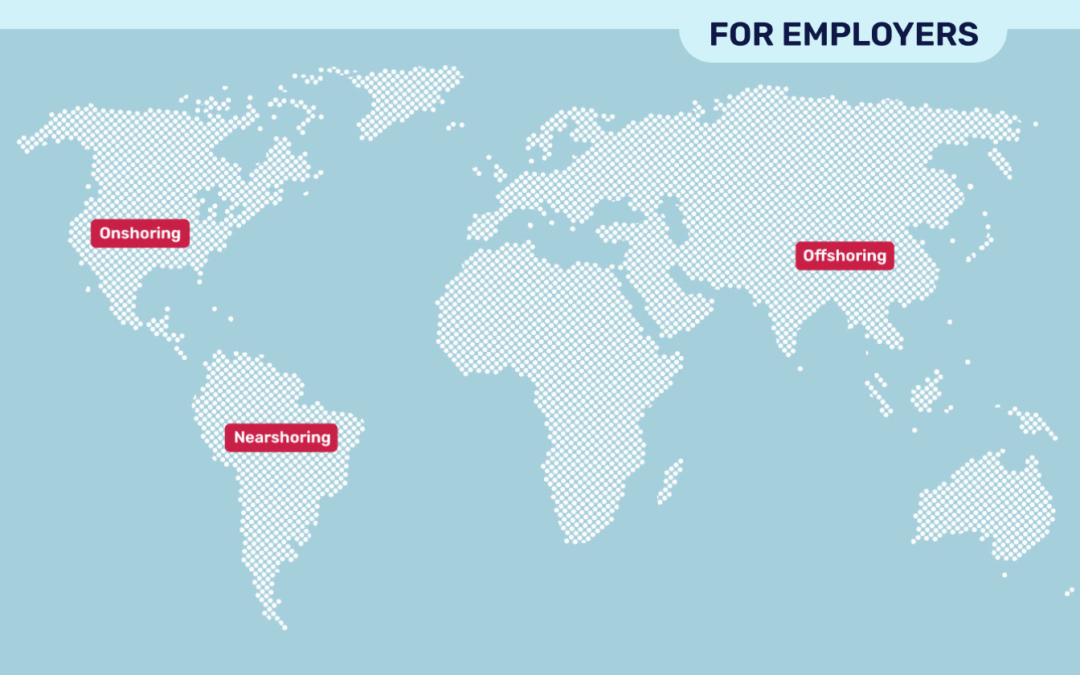

Onshore vs offshore vs nearshore

Onshore vs offshore vs nearshore

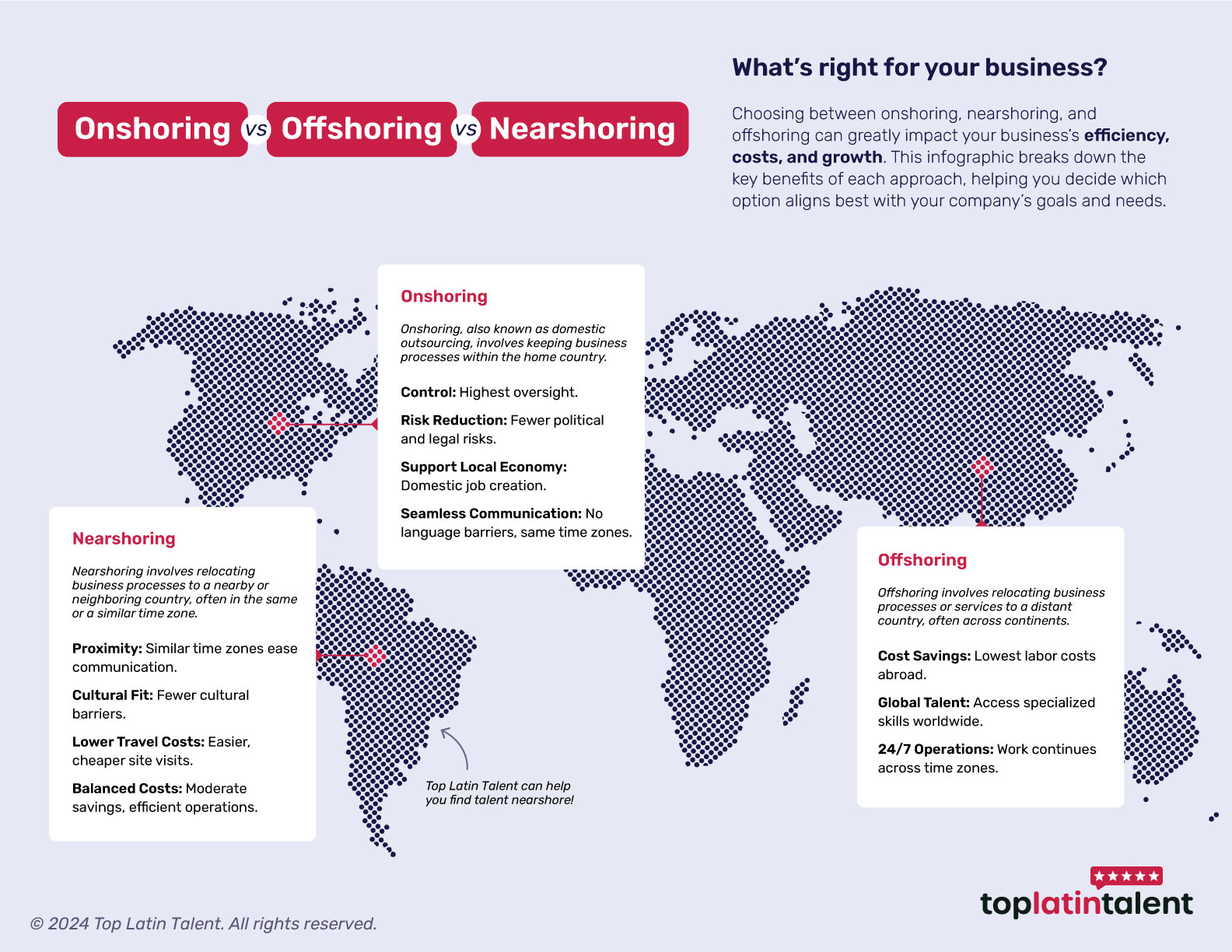
Onshoring vs nearshoring vs offshoring: what is right for your business?

onshoring vs offshoring vs nearshoring

In today’s globalized economy, businesses have more options than ever when it comes to expanding their operations and optimizing costs. Whether you are a startup looking to scale or an established enterprise seeking efficiency, the decision between onshoring, nearshoring, and offshoring can significantly impact your company’s success. But how do you determine which approach is right for your business?

This blog will explore the details of onshoring, nearshoring, and offshoring to help you make an informed decision. We will delve into the advantages and challenges of each strategy, offer real-world examples, and discuss how recruitment agencies like Top Latin Talent can help you find the right talent, no matter which approach you choose.

Understanding onshoring, nearshoring, and offshoring

Before discussing the advantages and disadvantages, it’s important to define onshoring, nearshoring, and offshoring.

  • Onshoring: This involves keeping business processes within your home country. For U.S. companies, this means working with domestic talent and resources. It offers the highest level of control and aligns with local regulations but often comes at a higher cost.
  • Nearshoring: Nearshoring refers to relocating business processes to a nearby or neighboring country, often within the same or similar time zone. For U.S. businesses, this might mean working with partners in Latin America or Canada. It balances cost savings with geographical proximity and cultural alignment.
  • Offshoring: Offshoring involves moving business processes to a distant country, typically across continents. Countries like India, China, and the Philippines are common offshoring destinations due to their lower labor costs. While it offers significant cost savings, it can also present communication and quality control challenges.
onshoring vs offshoring vs nearshoring infographic

Evaluating the benefits of onshoring, nearshoring, and offshoring

1. The benefits of nearshoring

Nearshoring offers a middle ground between the cost-effectiveness of offshoring and the control of onshoring. It’s a strategy that many U.S. companies find appealing, especially when looking to Latin America or Canada for talent.

Cost savings with proximity

Nearshoring offers significant cost savings compared to onshoring, though typically not as low as offshoring. However, the proximity to your home country often justifies the slightly higher costs. You benefit from lower labor costs while enjoying the advantages of a nearby location.

Cultural alignment

Cultural similarities between your home country and the nearshoring destination can lead to smoother collaboration. Shared business practices, language skills, and work ethics reduce the chances of miscommunication and help build stronger working relationships.

Convenient time zones

Nearshoring to countries in similar time zones facilitates real-time communication. This is crucial for projects that require frequent interaction between teams or when quick decision-making is essential.

Easier travel

The geographical proximity of nearshoring destinations makes it easier and more cost-effective for management to travel for site visits, training, or problem resolution. This can enhance collaboration and ensure better alignment with your business objectives.

Ideal scenarios for nearshoring

Nearshoring is ideal for businesses that must balance cost savings with operational efficiency. It’s beneficial for collaborative projects, customer service operations, and IT development where time zone alignment is critical.


2. The benefits of offshoring

Companies often choose offshoring to minimize costs, access a global talent pool, and scale operations quickly. It’s a strategy that has been embraced by many industries, from manufacturing to IT services.

Maximum cost savings

Offshoring offers the most significant cost savings due to the lower labor costs in countries like India, China, and the Philippines. This makes it an attractive option for labor-intensive tasks such as manufacturing, customer service, and data entry.

Access to global talent

Offshoring provides access to a vast global talent pool, especially for specialized skills that may not be readily available domestically. For instance, many companies offshore IT development to India due to its large and highly skilled workforce.

24/7 operations

Thanks to time zone differences, offshoring can enable 24/7 operations. Work can be done overnight in the offshore location, leading to faster turnaround times and increased productivity.

Scalability

Offshoring offers flexibility to scale operations up or down depending on business needs. This is particularly useful for companies experiencing rapid growth or fluctuating demand.

Ideal scenarios for offshoring

Offshoring is best suited for companies that prioritize cost savings and require access to specialized skills. It’s also ideal for processes that can be standardized and don’t require real-time collaboration.


3. The benefits of onshoring

Onshoring, or domestic outsourcing, is often chosen by companies prioritizing quality, control, and compliance. Here’s why:

Quality control and oversight

Onshoring allows businesses to maintain a high level of quality control. When your operations are based domestically, monitoring processes, enforcing standards, and ensuring compliance with local regulations is easier. This is particularly important in industries like healthcare, finance, and manufacturing, where quality and safety are paramount.

Reduced risk

Operating within your home country minimizes risks associated with political instability, currency fluctuations, and legal challenges. You’re also more familiar with the local business environment, which can reduce the likelihood of unexpected issues.

Seamless communication

Communication is typically smoother and more effective with no language barriers and the same time zones. This leads to quicker decision-making and fewer misunderstandings, which can be critical in fast-paced industries.

Economic contribution

Onshoring supports the local economy by creating jobs and contributing to domestic economic growth. This can enhance your company’s reputation as a responsible corporate citizen.

Ideal scenarios for onshoring

Onshoring is particularly suitable for high-stakes projects, where quality and compliance are non-negotiable. It’s also a good choice for companies that require close collaboration between teams and clients or need to adhere to stringent regulatory standards.


Challenges to consider

While each approach has its benefits, there are also challenges to consider. Understanding these will help you mitigate risks and make more informed decisions.

Onshoring challenges

  • Higher Costs: The primary downside of onshoring is the higher cost of labor and operations within the home country.
  • Limited Talent Pool: Depending on your industry, you may find it challenging to source specific skills domestically.

Nearshoring challenges

  • Moderate Cost Savings: While nearshoring is cheaper than onshoring, it doesn’t offer the same level of savings as offshoring.
  • Cultural and Legal Differences: Despite being geographically close, there can still be cultural and legal differences that require careful management.

Offshoring challenges

  • Communication Barriers: Language differences and time zone gaps can lead to miscommunication and delays.
  • Quality Control: Ensuring consistent quality can be challenging when operations are far from the home office.

Political and Economic Risks: Offshoring involves exposure to risks related to political instability, regulatory changes, and currency fluctuations in the host country.


How recruitment agencies can help

Whether you choose onshoring, nearshoring, or offshoring, working with a specialized recruitment agency can simplify the hiring process and help you find the right talent. Here’s how different agencies can assist with each approach:

Nearshoring recruitment

Top Latin Talent specializes in connecting U.S. companies with highly skilled professionals in Latin America. We understand the cultural and operational nuances of the region, helping you find the right talent quickly and efficiently. Nearshoring with Top Latin Talent perfectly balances cost savings, cultural alignment, and operational efficiency.

Other agencies, such as Michael Page and Alto Impacto, also focus on Latin America, providing access to a diverse talent pool across the region.

Onshoring recruitment

For onshoring, agencies like Robert Half and Kelly Services are well-known in the U.S. for their extensive networks of domestic talent. These agencies can help you find skilled professionals within your home country, ensuring quality and compliance with local regulations.

Offshoring recruitment

For offshoring, agencies like MicroSourcing and Outsourced are leaders in connecting businesses with global talent, particularly in the IT and business process outsourcing (BPO) sectors. These firms provide comprehensive offshoring solutions, offering access to skilled professionals in countries like the Philippines, while focusing on cost efficiency and quality service.

Are you looking to hire Latin American talent? Schedule a commitment-free meeting today with us to discuss your hiring needs.
Time zone alignment for North, Central, and South America

Time zone alignment for North, Central, and South America

Time zone alignment for North, Central, and South America and hiring oportunities

💡 Know US or Canadian companies that need LATAM tech talent?

Turn your connections into passive income! You can earn $250/month per developer placed—and even more for larger placements. No effort, just easy earnings.

🔗 Learn more about our referral program today!

Time zone alignment

Understanding time zone alignment is fundamental when you build remote teams to overcome the challenges of working in different time zones. Sometimes, different time frames can make communication more complicated, and shifts could get mixed when you outshore. However, time zone alignment can be more favorable between countries when nearshoring. This alignment presents opportunities, especially for companies in the United States and Canada looking to hire workers from Latin America.

Latin America is composed of the entire continent of South America, Mexico, Central America, and the islands of the Caribbean. The region is home to a diverse pool of highly skilled professionals across various industries, making it an attractive destination for businesses seeking remote talent.

South America is divided into five standard time zones (UTC-2/3/4/5/6). Except for Chile, Paraguay, Brazil, Easter Island, and the Falkland Islands, all the other countries follow the same time zone throughout the year. Although there are five time zones, the time difference between them is at most two hours. This minimal variance allows for seamless collaboration between companies in North America and professionals in South America. 

Central America uses one standard UTC-6 time zone and maintains the same time zone all year. The following countries are in Central America: Belize, Costa Rica, El Salvador, Guatemala, Honduras, and Nicaragua. This consistency makes it easier for companies to integrate professionals from this region.

Mexico, equivalent to the United States and Canada, uses four time zones (Central Standard, Pacific Time, Mountain Time, and Eastern Standard Time). The difference is that Mexico will remain on standard time year-round. The ten municipalities in Mexico that share a border with the United States will continue to observe a daylight-saving time pattern consistent with the United States.

Time zone alignment for North, Central, and South America 

1. UTC-2

Some parts of Brazil have this time zone.

2. UTC-3

Argentina, Uruguay, French Guiana, some parts of Brazil, and Suriname have this time zone all year. During daylight savings, Chile, Paraguay, and the Falkland Islands have this time zone.

3. UTC-4

Venezuela, Bolivia, some parts of Brazil, and Guyana have this time zone. Chile, Paraguay, and the Falkland Islands have this time zone during Standard Time, which matches North American Eastern Time during daylight savings time. This overlap is particularly useful if you think about hiring a UX Researcher in Brazil, who can conduct usability testing sessions with North American users in real-time, gathering valuable insights without scheduling conflicts.

4. UTC-5

Peru, Colombia, Ecuador, Panama, and some parts of Brazil have this time zone all year. Some parts of Chile (Eastern Island) have this time zone during daylight savings. This time matches North American Eastern Time during Standard Time and Central Time during daylight savings. Imagine a Bookkeeper in Colombia, the country with the first center for the Fourth Industrial Revolution in Latin America. If they are working in UTC-5 it’s possible to reconcile accounts and prepare financial reports during the same working hours as North American finance teams, ensuring timely financial oversight. 

5. UTC-6

Galapagos Islands, Eastern Island, Belize, Costa Rica, El Salvador, Guatemala, Honduras, and Nicaragua have this time zone. This time matches North American Central Time during Standard Time and Mountain Time during daylight savings. Businesses looking for professionals like Executive Assistants can benefit from this overlap to ensure real-time collaboration. For example, an Executive Assistant in Costa Rica can schedule meetings, manage calendars, and handle administrative tasks in perfect sync with U.S.-based executives.

Opportunities in latam

So, to keep it brief, time zone alignments at Central and South America, and Mexico, have several advantages in terms of consistency, flexibility, quality, costs, and optime time frames. 

For example, a Full Stack Developer in Argentina, trained at a higher education system recognized by Times, can work within UTC-3 and easily align with a U.S.-based development team, ensuring that debugging and code reviews happen in real-time.

Also, professionals such as SEO Specialists, Digital Marketing Specialists, and Social Media Managers from those countries can work without the complications of shifting time zones. For instance, a Social Media Manager in Guatemala can coordinate live campaigns with a U.S. marketing team without delays, ensuring timely responses to customer engagement.

We could also ensure that Customer Success Managers, Channel Sales Managers, and Sales Development Representatives become more accessible for U.S. and Canadian companies. A Customer Success Manager in Mexico City working in CST can maintain seamless communication with North American clients, ensuring high responsiveness and real-time issue resolution. 

Final ideas on time zone alignment

Hiring remote talent from these countries presents cost-saving opportunities and allows access to a diverse pool of highly skilled tech, marketing, sales, and administration professionals. Contact us whether you need a Data Engineer, Digital Marketing Specialist, or Customer Success Manager, and discover that Latin America offers a competitive talent market that aligns well with North American business hours. The strong time zone alignment ensures that remote teams can collaborate efficiently, increasing productivity and reducing delays

What is Nearshoring, and What Are Its Advantages?

What is Nearshoring, and What Are Its Advantages?

What is nearshoring, and what are its advantages? 

What is Nearshoring

Understanding What is Nearshoring

Companies constantly search for innovative strategies to improve efficiency and reduce costs in the globalized business environment. One important strategy is nearshoring. But what is nearshoring exactly?  this form of offshoring that has emerged as a practical option for companies seeking to leverage the advantages of neighboring countries. It involves the outsourcing of business operations to companies in close geographic proximity. By adopting this strategy, companies can foster collaboration with third-party providers in nearby countries, leading to more cost-effective services and minimizing the impact of differences in working hours and cultural barriers.  


What are the benefits of Nearshoring?


1. Cultural Connectivity and Market Understanding

Despite differences in countries, the relatively short distances promote more significant cultural connections, making it easier for businesses to understand local markets.

2. Economic Impact

Nearshoring positively impacts the economies of both countries involved. One country benefits from increased employment opportunities and improved quality of life, while the other enjoys cost savings and high-quality services.

3. Operational Control and Adaptability

The proximity allows the business to influence team performance and respond quickly to changes in project requirements.

4. Similar Time Zone Advantage

The proximity ensures a similar time zone, guaranteeing timely project deliveries and quicker response times. Similar time zones allow more accessible virtual teams’ decision-making, stability, and productivity.

5. Expanded Talent Pool

Offshoring opens opportunities to explore talent in other countries and reduces travel expenses if needed.

6. Intellectual Property Security

Having locations closer is considered safer for intellectual property, reducing the chance of theft. This provides companies with greater confidence in sharing proprietary information.


In conclusion, it’s a strategic choice for optimizing operations, cutting costs, and accessing a more extensive talent pool. With its cultural connectivity, economic impact, and operational advantages, Latin America stands out as an ideal region for companies considering nearshoring partnerships in North America. Adopting nearshoring ensures real-time collaboration and promotes a closer relationship.

Schedule a commitment-free meeting today with us to discuss your hiring needs.